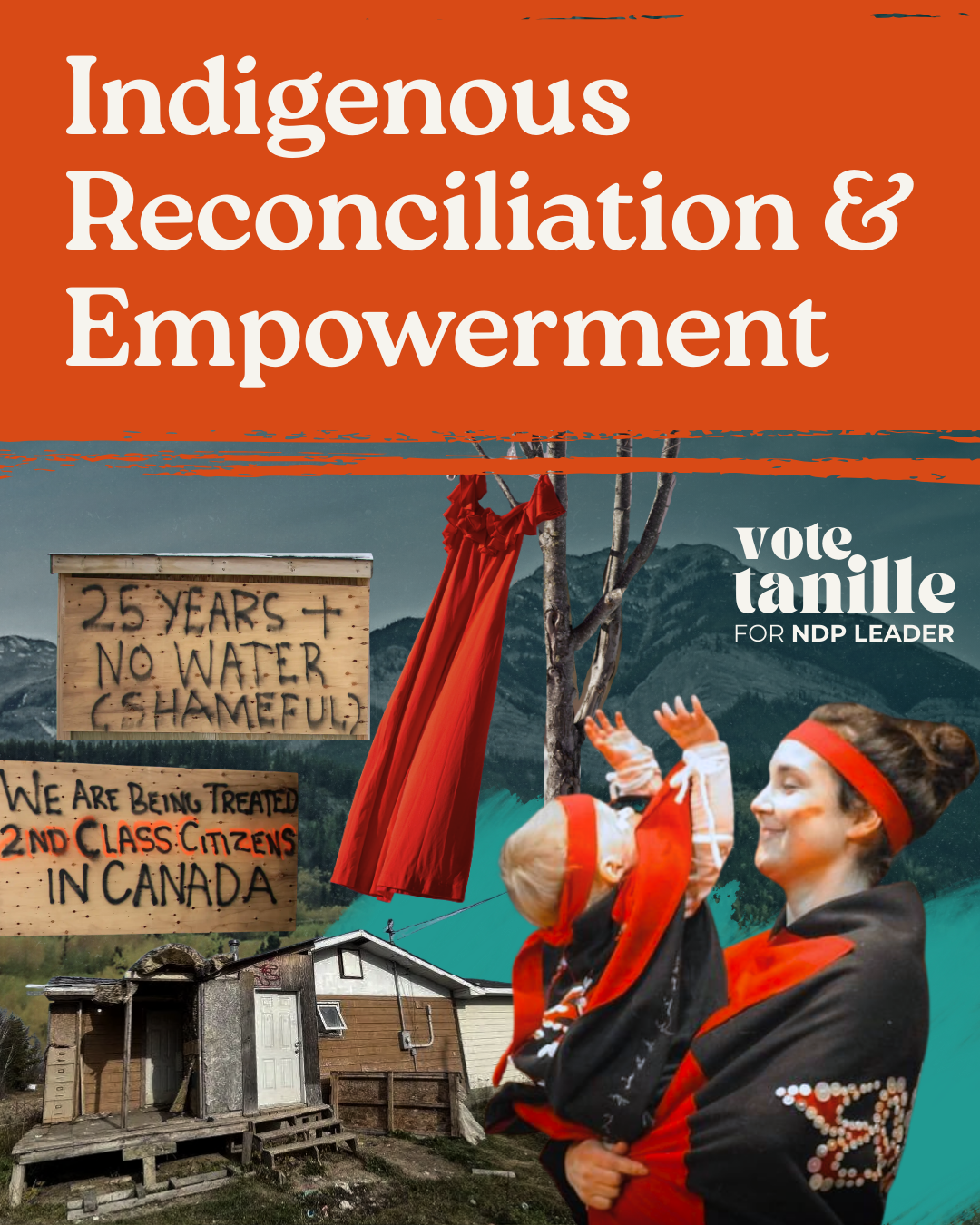
Indigenous Reconciliation & empowerment
Canada needs a nationwide journey to address historical injustices through reconciliation, grounded in the rights, respect, and partnership of First Nations, Métis, and Inuit. This campaign acknowledges that the abusive systems implemented to prevent Indigenous prosperity are genocidal and continue to exist today. Conservative and Liberal governments have consistently ignored cries for help from Indigenous communities, denying them basic human rights, land rights, and treaty-guaranteed rights.
We must work toward closing the infrastructure gap by 2030 by directly engaging with communities to address issues such as boil water advisories, the absence of ballot boxes, and inadequate transportation. We will fully commit to funding Jordan’s Principle and begin addressing the estimated 135,000 backlogged requests. Most importantly, we will listen to Indigenous leaders, community members, and reconnecting citizens to gain a precise understanding of the specific needs of their communities. All actions will be carried out with free, prior, and informed consent of Indigenous nations, reinforcing their right to say “no,” demand changes, or set conditions.
There are five key parts to accomplishing this:
Closing the Infrastructure Gap by 2030
Truly Practicing Free, Prior, and Informed Consent
Enabling Democratic Access for Indigenous Communities
Combating Violence Against Indigenous Women, Girls, and Two-Spirit People (IWG2S)
Fixing Broken Promises
Closing the Infrastructure Gap by 2030
-
The Federal Government has a responsibility to ensure the well-being of Indigenous communities is met. We are committed to supporting the Assembly of First Nations (AFN) in advancing equitable standing for Indigenous peoples in Canada. This includes partnering with Indigenous communities to close the infrastructure gap by 2030.
Closing the infrastructure gap is an economic opportunity for Canada—generating $635B in output, 2.4M jobs over the next seven years, and $87B in government revenue.
-
Significant investments include: all-weather roads, housing on and off First Nations, high-speed broadband, and airports to improve access to essential services and advance economic reconciliation.
Through these investments, we can employ Canadians nationwide to build this infrastructure, provide access to basic services for rural and Indigenous communities, and take a significant step toward achieving economic reconciliation for Indigenous peoples in Canada.
-
The climate crisis hits underserved communities first and hardest. Strong infrastructure paves the way for better climate adaptation, especially for travel-related emissions.
Within remote communities that rely on ice roads, climate change shortens the number of months those roads are safely accessible. Warmer temperatures cause later freezing and early thawing. With proper infrastructure, travel can be more convenient and affordable during early melting.
Indigenous communities have already made significant efforts to build climate resilience, but they cannot address the challenges of climate change in isolation.
-
Access to safe and clean drinking water is a human right. Enough is enough. It’s time we enshrine that right to water into Canadian law. A legal right to safe and clean drinking water must be grounded in inherent rights and treaty rights of Indigenous Peoples, aligned with international human rights law regarding water, include provisions for effective source water protection, and must be drafted in consultation with First Nations.
The update provided by the Government of Canada on Nov. 18th, 2025, indicated 36 First Nations communities still had 38 long-term drinking water advisories (80% completion rate). We are dedicated to the commitment to bring this number to zero.
The AFN estimates that addressing boil advisories in Indigenous communities would cost approximately $0.7 billion in 2023, and has the potential to increase to $2.5 billion if left unchecked.
Restoring access to safe water eliminates the various burdens and risks associated with needing to boil water for all consumption purposes. It reduces health risks, lowers daily costs for households, and ensures reliable access to clean drinking water for all community members.

True Free, Prior, and Informed Consent
-
Free, prior, and informed consent must mean Indigenous communities can refuse projects, demand changes, or set conditions—not simply be told after life-changing decisions have already been made.
That means repealing Carney’s C-5 bill, which fast-tracks developments without First Nation consultation and conflicts with the legal standard of free, prior, and informed consent.
We must commit to ensuring Indigenous peoples are full partners in decision-making.
-
By partnering with Indigenous communities on nation-building projects that are important to them, we will ensure Indigenous communities are leading participants in decisions affecting their lands and resources.
-
To respect the principles of free, prior, and informed consent, we must listen to calls from First Nations and revoke the federal-Alberta Memorandum of Understanding.
Current structures lack direct representation in some regions and territories. True consent requires full and inclusive representation.
-
The federal government allows foreign corporations to control major projects, limiting benefits for both Canadians and Indigenous nations whose lands are used for development.
We must ensure that Indigenous communities play a direct role in major project decisions. This would provide communities with stronger authorities to set their conditions on projects.
Democratic Access for Indigenous Communities
-
Since its implementation in 1960, access to voting has continuously been denied to Indigenous communities across Canada. We must guarantee the provision of ballot boxes to every Indigenous and underserved community across the country.
The federal government is still falling short, as shown by the early closing of ballot boxes in Nunavik during the 2025 federal election. Limiting participation will weaken Indigenous peoples' trust in democratic institutions.
Accessible voting must be a national priority, independent of any political gain. Ensuring ballot boxes in every Indigenous community fosters representation and self-determination, and the ability to influence policy that directly affects them.
-
We support Indigenous communities' who wish to assume their right to manage their own police service and are committed to funding community-led policing.
As Canada enters a new age of Indigenous law, Indigenous communities require the ability to enforce justice systems that align with their communities' needs.
These services integrate Indigenous values, strengthen safety, and provide culturally informed, effective law enforcement while building trust within communities.
Indigenous policing should address pressing threats such as the drug trade and criminal organizations in ways that are culturally appropriate and genuinely effective. Localized control will improve safety with respect to Indigenous knowledge.
Decades of abuse from legal authorities have led to widespread distrust of law enforcement in Indigenous communities.
Granting Indigenous communities greater control over policing through self-governance is essential to rebuilding trust.
Combating Violence Against Indigenous Women, Girls, and Two-Spirit People
-
This campaign is committed to funding culturally safe shelters, accessible health services, and community-led prevention programs to protect Indigenous women, girls, and Two-Spirit people from the disproportionate violence they continue to face.
Full implementation of the 231 Calls for Justice from the National Inquiry into Missing and Murdered Indigenous Women and Girls (MMIWG) to address the systemic genocide of violence against Indigenous women, girls, and 2SLGBTQQIA+ people.
-
Timely warnings and coordinated responses are crucial in the fight to protect Indigenous women, girls, and Two-Spirit people who are at risk.
All designed in partnership with Indigenous communities to address their levels of systemic violence and support survivors.
-
Interpretation and implementation of all proactive actions must include dedicated funding to make trauma-informed approaches viable. All necessary steps—training, support, culturally safe healing, etc.—are properly resourced in ways that recognize intergenerational and active traumas without causing further harm.
Fixing Liberal Broken Promises
-
Jordan's Principle must be fully funded to ensure Indigenous children can access medically necessary items, including health care, education, and social services, without delay. Proper funding is a moral and legal obligation.
With an estimated 135,000 backlogged requests in 2025 unfulfilled, addressing the backlog and investing in the teams and organizations built to manage it, we can restore trust with Indigenous communities. We must eliminate the backlog.
Let’s ensure that the government is prioritizing investment in services not legal battles with First Nations. – public funds should be used to strengthen Jordan’s Principle. Spending government resources on legal battles that stall its processes is counterintuitive. Investing directly in services will improve said services in Indigenous communities.
-
Canada must ensure that federal laws fully align with the principles of UNDRIP, committing to protecting Indigenous peoples' inherent rights to self-determination, culture, land, and resources.
-
With only 14 being completed as of 2025, the federal government must fully implement the TRC Calls to Action. Particularly, the currently inactive calls to action pertaining to child welfare, education, and health, that have not been completed.
In partnership with Indigenous communities, reconciliation efforts can be implemented more effectively; too often, they are delayed or blocked. That is unacceptable.
-
Food prices in the North are out of control, contributing to a severe hunger crisis in Nunavut where more than 40% of Inuit children arrive at school hungry. Meaningful reform and increased investments are needed to lower food costs and ensure equitable access in northern, remote Indigenous regions and Nunavut.
We must ensure 100% pass-through of subsidies to consumers, expansion of the list of eligible nutritious foods and essentials, and an increase in funding levels to meaningfully reduce high food prices.