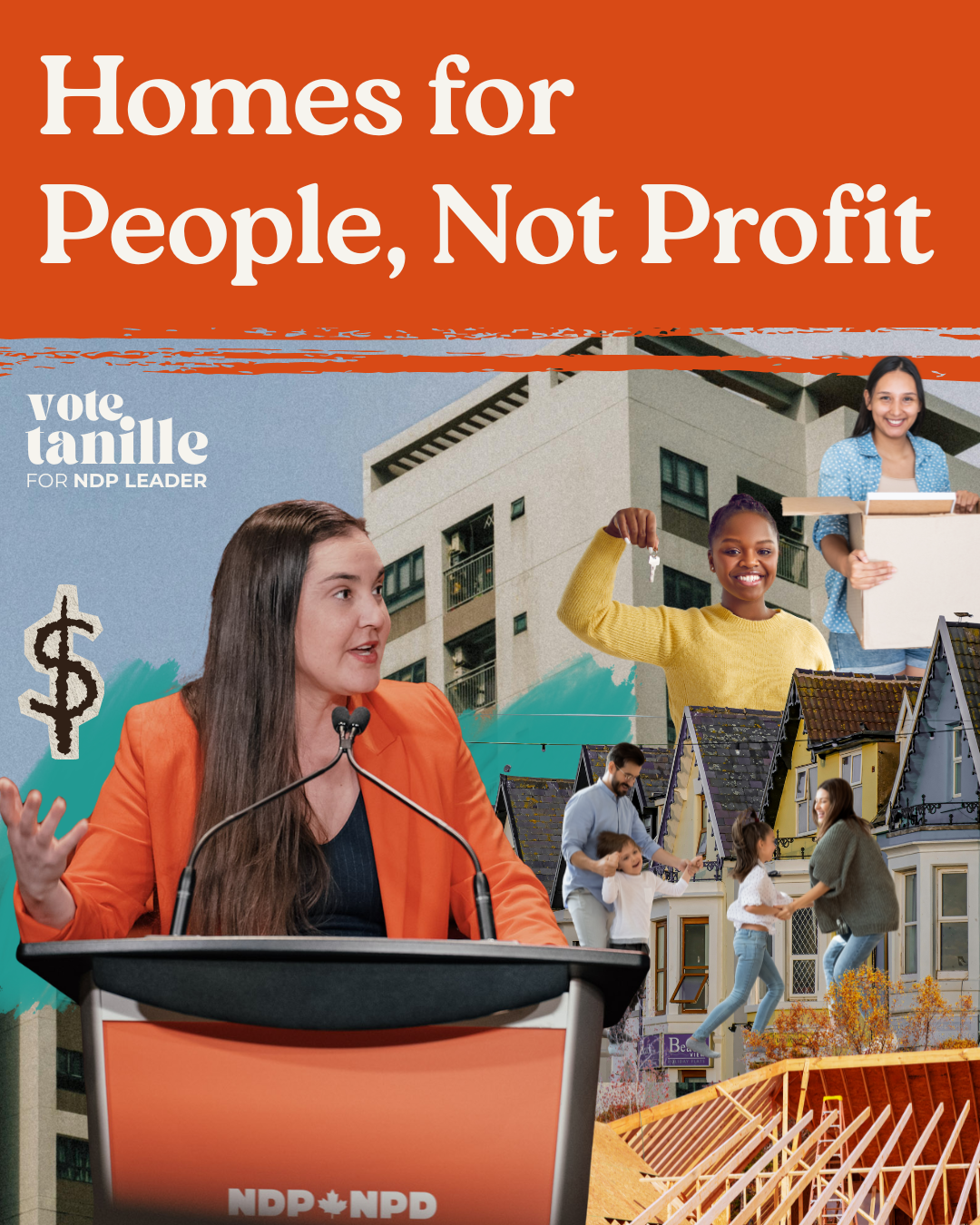
Homes for People,
Not Profit
Housing is a human right, and right now the high cost of housing is tearing at the social fabric of this country. Housing should not be used as an investment asset for wealthy investors and corporate elites. Rent remains too high, and buying a home is completely out of reach for many all the while families are struggling to keep a roof over their heads.
Canada is a G7 country, yet hundreds of thousands of people experience homelessness each year, with Indigenous people vastly overrepresented.
We need 480,000 new homes every year to restore housing costs to early-2000s levels, which is nearly double the number currently being built.
But affordability shouldn’t just be a buzzword. The federal government needs to take an active role in lowering both home prices and rents.
Canada must once again take an active role in solving the housing crisis. That means building more homes, strengthening renter protections, expanding non-market housing, and taking on the financialization of housing, so homes are for people, not profits.
There are five key parts to accomplishing this:
Prioritize Public, Not-for-Profit & Co-Operative Housing
Ensure Renters Are Protected
De-Commodify Housing & Build Canadian
Build Homes Better, Faster
Indigenous First Housing
A Public Builder Working with Non-Profit and Co-operative Housing Providers.
-
The private market has failed to provide Canadians with the quality and the number of homes needed to deliver adequate, safe and affordable housing. That’s why it is time to create a Crown corporation responsible for directly building affordable housing across the country.
The Public Builder would include three operational arms: a construction arm, a land acquisition arm, and a housing operations arm that builds affordable, safe housing in partnership with co-ops, non-profits, community housing providers, and civil society organizations to deliver affordable, accessible, and permanently non-market homes.
-
We will prioritize construction of co-operative housing, community land trust housing, and non-profit rental housing to permanently expand Canada’s stock of non-market homes and put downward pressure on rents and housing prices.
-
Allow the Public Builder to build co-op and affordable rental housing developments on public land, prioritizing housing near existing transit and urban infrastructure.
-
Create a federal acquisition fund that partners with non-profits and housing co-operatives to purchase existing rental buildings that are vacant, underused, or in need of repair, and transfer them to community housing organizations to preserve long-term affordability.
Ensure Renters Are Protected
-
It is time for strong rent control nationwide. A Tanille led NDP will tie federal housing funding to provinces adopting strong rent control frameworks that limit Landlord’s ability to jack-up the tenants rents.
-
When tenants move out of a property landlords can just increase the rent for the next tenant. It is time to ensure that rental units remain subject to rent control even when tenants change, preventing landlords from dramatically increasing rents between leases and preserving truly affordable housing.
-
It is time to ban bad-faith evictions carried out under the guise of renovations and guarantee tenants the right to return to their homes at the same rent following legitimate repairs.

De-Commodify Housing & Build Canadian
-
Financialized landlords purchased 90 per cent of all rental stock that came up for sale in Toronto in 2020. That is why it is time to limit the ability of large financial landlords, like Brookfield Asset Management, and Blackstone from buying up housing and jacking up the price so it is unaffordable for working-class Canadians. Housing is a human right, not a commodity to be traded for profit.
-
It is time to introduce stronger federal taxes on speculative housing activity, like was introduced in BC including rapid property flipping and large-scale investor purchases of residential housing. We also have to get rid of the REIT tax loophole that encourages the finalization of the housing market.
-
Support the use of Canadian softwood lumber and mass timber in residential construction so that we empower our lumber sector, and strengthen domestic supply chains for building materials.
-
Establish a Universal Heat Pump Program, overseen by a new publicly-owned entity that produces, distributes, and installs heat pumps in homes across the country. With built-in tenant protections, this program would save lives, cut our bills, and protect the planet.
Build Homes Better, Faster
-
Through the CMHC, we should incentivize modular and prefabricated housing construction in Canada to rapidly scale up the supply of affordable homes and reduce construction timelines and costs . By supporting domestic manufacturing capacity and encouraging innovation in off-site building methods, Canada can deliver housing more quickly and efficiently than through traditional construction alone. CMHC should play a central role in identifying priority regions with the greatest housing shortages, coordinating financing and investment, and guiding an efficient national rollout so that new homes are built where they are needed most.
-
Incentivize municipalities to legalize fourplexes and sixplexes in residential neighbourhoods and expand “missing-middle” housing to reduce urban sprawl and make better use of existing infrastructure.
We need the Federal government to promote more density in urban areas, including limits on single-family-only zoning, maximum lot sizes for detached homes, and targets for the share of housing that must allow multi-unit development within municipalities and regional districts. These measures would help ensure cities grow more efficiently while increasing the supply of family-sized homes in walkable communities.
-
The federal government must also use its spending power to ensure municipalities are part of the solution. Federal housing and infrastructure funding should be tied to clear, enforceable pro-housing reforms, including ending exclusionary single-family-only zoning, allowing fourplexes and sixplexes as-of-right, eliminating parking minimums, and preventing the underuse of serviced land.
Indigenous First Housing
-
First Nations communities face some of the most severe housing shortages in Canada, with at least 157,453 new homes needed to address the crisis.
We will end the federal government’s year-to-year, pay-as-you-go approach and replace it with long-term, predictable, multi-year funding that communities can rely on to plan, build, and maintain housing.
Funding will support housing that is designed, led, and built by Indigenous communities, advancing self-determination and ensuring solutions reflect local needs.
We will also invest in training and construction certification programs, building local capacity so communities can construct homes themselves, creating jobs while addressing the housing crisis.
-
Indigenous people in urban areas are up to ten times more likely to experience homelessness than non-Indigenous people, yet federal housing policy continues to ignore the distinct realities of urban Indigenous communities.
We will establish a dedicated Urban Indigenous Housing Strategy, backed by stable, multi-year funding.
Funding will flow directly to Indigenous housing providers and organizations, including proven leaders like M’akola Housing Society, with a track record of delivering culturally appropriate housing.
We must not only fund new housing, but also invest in long-term operations and support needed to ensure people remain safely housed.
-
With 39% of Nunavummiut in core housing need and one-third of Inuit living in homes requiring major repairs, the federal government must treat this crisis with urgency.
We will invest in new housing across Nunavut, including prefabricated homes that can be deployed quickly in northern conditions.
This will be paired with long-term funding for maintenance and dedicated support for mold remediation, ensuring homes are safe, durable, and healthy.
-
Too often, the lack of basic infrastructure prevents new homes from being built in First Nations, Inuit, and Métis communities.
We will invest in essential infrastructure—including roads, water systems, broadband, and energy—as a core part of an Indigenous housing strategy, so homes can be built safely and affordably.
These investments will be made in partnership with Indigenous communities, supporting Indigenous-led planning and construction.
We will also support integrated community development, pairing housing with essential services such as healthcare infrastructure, childcare, schools, and local economic infrastructure.
Better coordination across federal programs will enable mixed-use developments, housing alongside clinics, pharmacies, and public grocery stores, so Indigenous communities can thrive with full access to essential services.